


Lightweight Ceramic Tile Adhesive TA350 SUPERLITE®
-
Detail
Lightweight Ceramic Tile Adhesive TA350 SUPERLITE®
Product Description
EasyMix ® SUPERLITE ® Flexible Series High-Strength Adhesive is a modified cement-based powder formulated withcement, selected lightweight aggregates, and polymer additives. Among them, the Flexible Adhesive C1T is suitable forceramic tiles. It provides strong bonding strength and a degree of flexibility, effectively solving the problem of ceramic tiles cracking after wall application.
Product usage
Suitable for bonding imported ceramic tiles and small-format porcelain tiles on interior/exterior walls and floors.
Advantages
1.Lightweight material, high coverage rate
2.Strong bonding strength
3.Excellent water resistance
4.Excellent weatherability and long-term durability
5.Suitable for thin-bed application
6.Long open timeSpecification & Technical Data:JC/T 547 -2017 C1T
Application
一,Substrate Surface Preparation
1.Make sure that the substrate surface is clean and saturated wet without free running water on the surface
2.Defects in the substrate surface should be repaired beforehand, and knock-outs if there are bumps and itis recommended to use EasyPlas repairmortar to repair.
3.Concrete walls and cement mortar plaster surfaces should be matured to required strength beforeapplication.
4.All base course grooves and holes must be pre-repaired with reinforcing mesh installation. No liability willbe assumed for cracking issues caused bysubstrate mortar conditions.二,Mixing
1.In the appropriate container, first pour a measured amount of water, and then slowly add the drypowder according to the proportion, use the electricmixer to mix fully at low speed for 3-5minutes, while pouring the powder and mixing to a uniform slurry (similar to paste) withoutlumps and withoutprecipitation. Let it stand for 1 ~2 minutes, then mix for 1 ~2 minutes to use.
2.Do not add any material outside of the ratio to the tile adhesive, including excessive water, cement,or river sand.三,Application
1.Ensure that the substrate surface is saturated wet and free of surface running water. Apply evenlyalayer of adhesive onto the substrate surface withan appropriate notched trowel and comb intoastripe form.
Note : use the proper sized notched trowel to ensure full bedding of the tile.
2.Next,butter the back of the tile with athin layer of adhesive mortar.
3.To inspect whether the tile is fully embedded onto the substrate, just pull out one of the tile while themortar still wet , check the coverage of theadhesive mortar on the back side of tile is it compliancewith the requirement .
4.Adjust the tile to the required level .
5.Plastic positioning crosses are inserted into the brickjoints to ensure that there are gaps betweenthe tiles to reduce stress induced damage.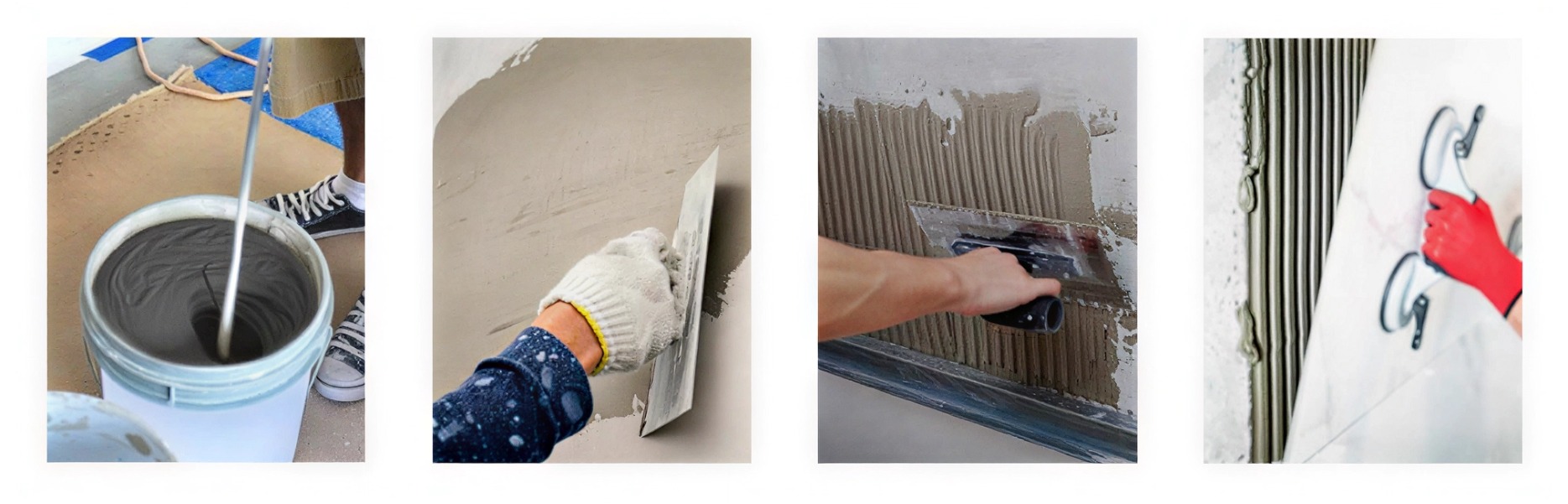
-
Customer ReviewsNo comments